
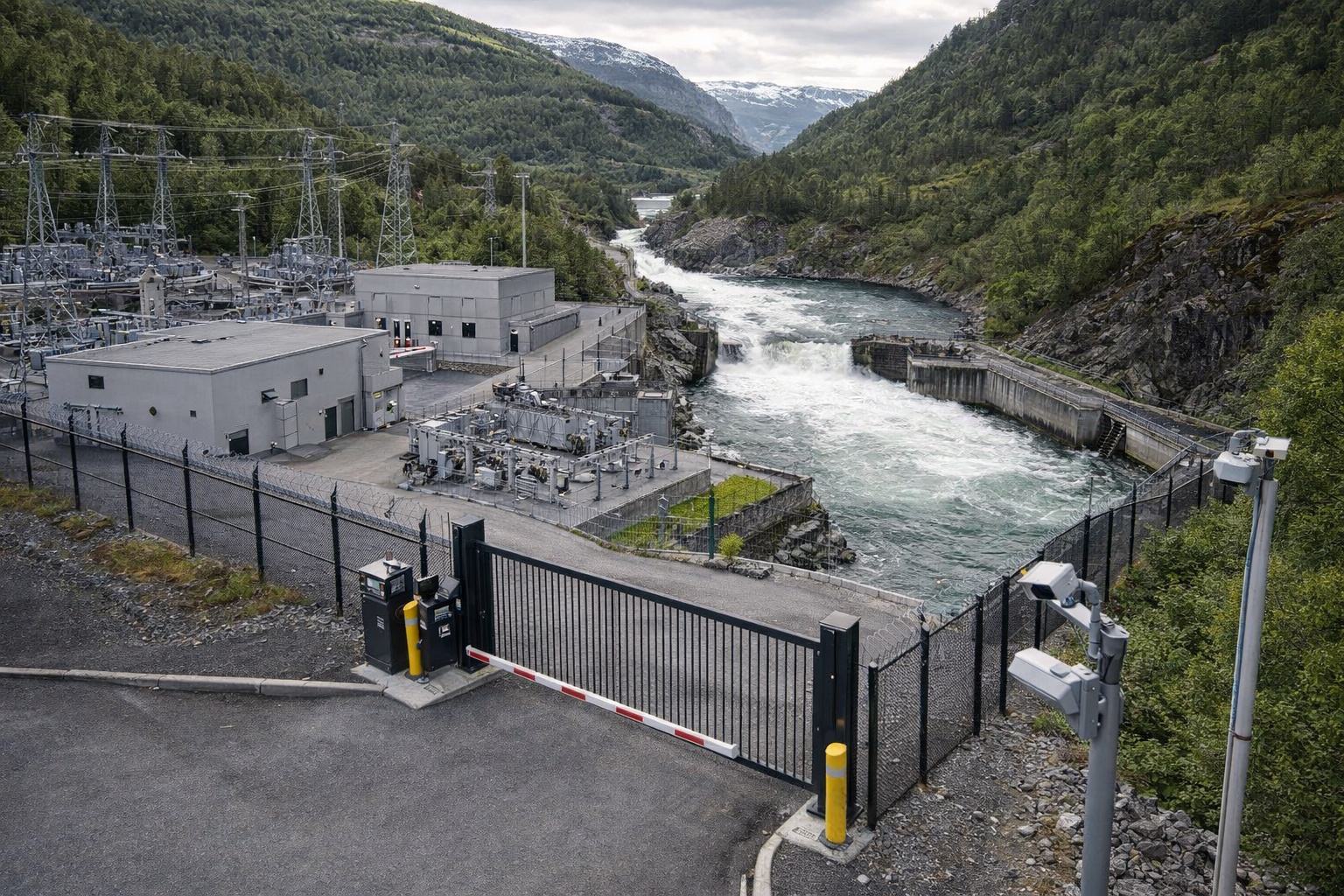
Critical Infrastructure
Power supply, water and sewage, telecommunications, transport and public institutions – these are installations society cannot function without. The security protecting them must be built on a systematic assessment of assets, threats and vulnerabilities, and the technical implementation must fulfil the requirements arising from the Security Act, the object security regulations and relevant authority guidelines. Solid Sikring delivers the technical security installations that make it possible to comply with risk assessments and security plans – from perimeter protection and access control to intrusion alarms and CCTV.
Challenges for critical infrastructure
Critical installations operate under an entirely different threat landscape than ordinary commercial buildings. Requirements for physical security come from multiple directions – authorities, industry regulations and an increasingly complex risk environment – and the consequences of failure can extend far beyond the individual organisation.
Regulatory requirements and compliance framework
The Security Act, object security regulations and guidelines from NSM, DSB and sector authorities set clear expectations for physical security, access management and documentation. For organisations designated as protected objects, specific requirements apply to security classification and technical design.
Risk assessment as the basis for measures
NSM's basic principles for physical security focus on protecting assets and functions against unauthorised access, intrusion, damage or loss. The principles describe what an organisation should do and why – but not necessarily exactly how. Implementing the technical solution is where Solid Sikring contributes.
Targeted threats and sabotage
Critical infrastructure is an attractive target for organised crime and state actors. The risk of sabotage, break-ins and unauthorised access requires security systems that detect and alert early – dimensioned for threats far beyond what an ordinary business needs to address.
Uptime and redundancy requirements
Security systems for critical infrastructure must operate 24/7/365 without exception. This means redundant communication paths, backup power, automatic failover and self-monitoring systems – so a component failure never results in a security gap.
Documentation and traceability for inspection
Inspections and audits require complete traceability – who had access, when were alarms triggered, which incidents were handled and how. Digital systems from access control, cameras and alarms generate automatic logs exportable for audit purposes.
Integration and modernisation
Many critical facilities have existing security systems from different vendors and generations. The challenge is to modernise without creating vulnerable transition phases, and to bring everything into one unified platform with a common operator interface.
Technical security solutions for critical infrastructure
Solid Sikring designs and installs security systems tailored to the requirements and risk assessments applicable to the specific facility. Each solution is built from the outer perimeter to the innermost security zone, in accordance with applicable standards and regulatory requirements.
Perimeter protection with electronic detection
Protection of outer boundaries with thermal cameras, radar detection, fence sensor cables and video analytics. The system provides early warning of intrusion attempts and integrates with lighting, speakers and automatic barriers for active response.
Access control with zone-based management
Multi-level access control managing access from the outer perimeter to the most sensitive zones. Supports card readers, biometrics, PIN and multi-factor authentication – with full traceability, time-limited access for subcontractors and exportable logs for audits.
Intrusion alarm to EN 50131
Alarm systems certified in accordance with EN 50131. For the most sensitive installations, systems are supplied to Grade 3 – the highest level formally used in the Norwegian market. Redundant signal transmission via IP and mobile network ensures alarms always get through, even during sabotage of communication lines.
CCTV with video analytics
High-resolution cameras with video analytics for automatic detection of movement, objects and behaviour. Thermal cameras provide visibility in darkness and poor weather. Everything is stored encrypted with sufficient retention time for investigation needs and audits.
Redundant systems and backup power
Critical components are duplicated with automatic failover. UPS and backup generators ensure operation during power outages. Systems monitor their own status and alert on deviations – enabling proactive maintenance.
Centralised management and integration platform
All security systems are brought together in one management interface. Operators get real-time overview of events, alarms and access across zones and locations – with detailed reports and export capabilities for inspections and audits. Integrated across access control, cameras and alarms in one platform.
What should an organisation do – and why?
The Norwegian National Security Authority (NSM) has developed a range of guidelines and handbooks describing basic principles for physical security. The starting point is to protect assets and functions against unauthorised access, intrusion, damage or loss. The guidelines focus on what an organisation should do and why – but do not always specify exactly which technology to use. This is where Solid Sikring contributes: we know the requirements, interpret the risk assessments and implement the technical solution that makes the principles operational in practice.
-
Defence in depth
Physical security is built in concentric zones – from the outer perimeter inward to the most protection-worthy assets. Each layer should delay, detect and prevent unauthorised access.
-
Detection and response
A good security installation detects intrusion attempts as early as possible – providing time for a controlled response. Early detection is more valuable than strong deterrence alone.
-
Traceability and documentation
All access events, alarms and security incidents must be logged and retrievable for inspections and incident investigations. Digital systems do this automatically.
-
Proportionality and risk-based approach
Security measures must be proportionate to the assets being protected and the actual threat picture. NSM's guidelines provide the framework – the risk assessment provides the direction.
Map assets and threats
Start by identifying which assets and functions need protection, and assess the threat landscape. NSM's guidelines provide a structured framework for this process.
Define security levels and zones
Determine which security gradients are needed – from the outer perimeter to the innermost protected zone. Access levels and documentation requirements are defined per zone.
Technical specification
Solid Sikring translates the security requirements into a technical specification: which systems, products and integrations are needed to meet the requirements.
Installation, testing and documentation
Professional installation with FAT/SAT testing and complete technical documentation – ready for inspection by NSM, DSB or sector authorities.
Recommended services
Based on the needs in this industry, we recommend the following services.
High Security
Custom solutions for high-security objects.
Perimeter Security
Protection of outer boundaries with sensors and CCTV.
CCTV
Professional surveillance systems with modern IP cameras, intelligent video anal...
Access Control
Control who has access to your building. From simple code locks to advanced biom...
Drone Detection
Detection, identification and neutralisation of unauthorised drones over critica...
Protect your critical infrastructure
Responsible for securing a critical facility? Contact us for a no-obligation review of technical requirements and solutions – we know the regulations and can guide you from risk assessment to a fully installed and documented security system.
Get in touch